-
Our Community
-
- Welcome Visitors About Durham's Community Climate Remembrance Project Diversity Welcome Statement Life in Durham Places to Stay Places to Eat Places to Park Transportation Schools Oyster River School District Welcome New Homeowners
- Durham Public Library Programs & Events Trails and Town Lands Conservation Commission Land Stewardship Conservation Lands & Parks Conservation Easements Trails Youth Organizations University of New Hampshire Durham Preservation Durham Historic Association
- Volunteer Town of Durham Land Stewardship Public Library UNH Cooperative Extension Churchill Rink Parks & Recreation Recreation Program Calendar Outdoor Recreation Activities Outdoor Recreation Sites Sustainable Durham Recycling Information Swap Shop Information Earth Day 2023
-
- Doing Business
-
Inside Town Hall
-
- Departments Assessing Building Business Office Code Enforcement Information Technology Planning Town Clerk/Tax Collector Parks & Recreation Boards, Commissions & Committees Agricultural Commission Conservation Commission Historic District/Heritage Comm. Other Boards & Committees Planning Board Zoning Board
- DCAT Media Productions DCAT Media - Programming DCAT Media Livestream Zoom Video Meeting Schedule Town Council Town Administration Public Hearings Public Safety Police Fire McGregor Memorial EMS (Ambulance)
- Public Works Engineering Division Operations Division Sanitation Division Water Division Wastewater Division Stormwater Town Directory Telephone Directory by Department Services Directory
-
-
Helpful Resources
-
- Quick Links Assessors Online Database Bids and RFP’s DCAT Media Productions GIS Digital Maps Jobs Online Services Parking Information Social Services Town Holidays Trash Pick Up Holiday Schedule Transfer Station & Recycling Center Information Curbside Refuse Collection by Street Zoom Video Meeting Schedule
- Town Documents Budget & CIP Forms & Applications Master Plan Tax Increment Finance (TIF) Districts Tax Maps Town Charter Town Code Town Reports Town Wide Master Fee Schedule Zoning Ordinance Voter Information
- Contact Us Cemetery Information Social Media Facebook Twitter Town Newsletter Friday Updates Town Meetings & Events Agenda and Minutes Calendar Public Hearing Notices State & U.S. Representatives
-
Community Power -- Values and Challenges
Brief History
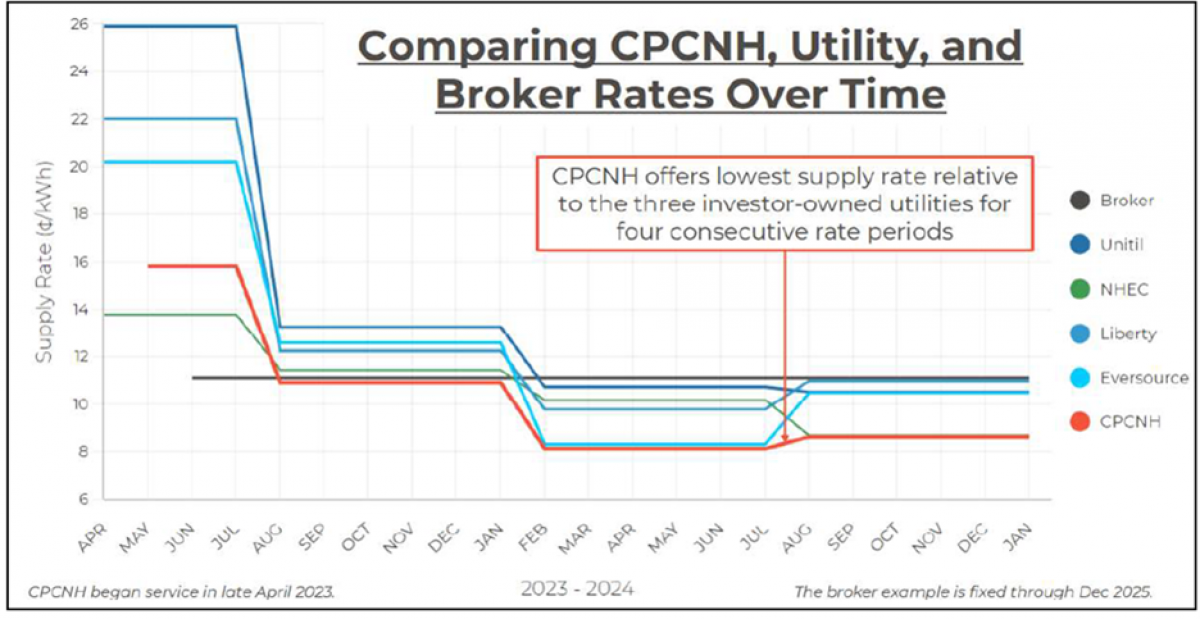
When the Community Power Coalition of New Hampshire (CPCNH) provided power to their first member communities in April of 2023, the Utilities were mandated by law and the Public Utility Commission (PUC) to purchase power in advance, in 6 month increments, to minimize risk. The introduction of community power programs, which have more flexibility to purchase short and long term pricing contracts, challenged the status quo and resulted in substantial reductions in consumer prices and increased competition, as evidenced in the above chart. The advent of CPCNH on the NH power market brought prices down dramatically, and narrowed the competitive differences, helping NH consumers save millions on their electric bills. CPCNH is proud to have saved NH residents millions of dollars over its first two years, and helped establish a more competitive power market.
CPCNH is a Start-up
During this start-up period, CPCNH was positioned to compete aggressively on price, while at the same time building up a financial reserves fund that would insure against unexpected expenses. This allowed CPCNH to “meet or beat” the default Utility prices for their member communities and provided millions of dollars in savings to their residents. As the PUC allowed more flexibility in power purchasing for the Utilities, the cost to consumers came down, and the variation between utilities decreased. This is the current marketplace where CPCNH now competes, and consistently competing on price alone is no longer possible. In addition to the marketplace changes, CPCNH faces other challenges common to start-ups.
Cash Flow and Financing Costs. Electric power contracts are paid as “up-front” costs in advance of usage, while revenue lags as meter reading, billing cycles, Utility payments to CPCNH, and regional market settlements stretch out over many months. The time delay between expense and revenue currently must be managed either by maintaining a large reserve fund to buffer the cash flow, or by financing with short term loans. Due to last year’s unusually cold winter and unexpectedly high power prices, CPCNH’s reserve fund was substantially depleted, requiring the increased use of short term credit to manage cash flow. To remedy this, a temporary 2 cent addition to the February rate was included to replenish the fund within 2026. This necessary step will have will have two critical benefits: (1) as the reserve fund increases, the financial rating of CPCNH strengthens, allowing the negotiating of lower interest financing; and (2) once the reserves increase sufficiently to manage the cash flow issue, the short term financing will no longer be needed. As these costs come down, the savings will be passed on in lower future rates. Within a few years, CPCNH expects to have sufficient reserves to eliminate this cost entirely.
Contracting vs. In-house. As a start-up organization, CPCNH needed to “hit the ground running” when offering service to their first member communities, and thus needed to contract out certain critical functions that could not be done by their small staff, such as power contracting, usage and billing functions, demand forecasting and simulations, and a customer call center. This allowed CPCNH to provide quality service on day one, but also incurred additional cost overhead from all these contractors. As CPCNH has grown, staff have gradually been added to provide internal expertise and reduce the dependence on external firms, allowing a continued reduction of this overhead over time that will result in lower prices.
CPCNH -- Consumer Based Values
CPCNH was founded to specifically address the need for improved consumer options in the electric power market for both prices and cleaner energy sources. This is being addressed in multiple efforts:
Market Innovation
CPCNH leads through initiatives like the NH Energy Forward Act, leading the state toward a more dynamic and modernized energy system that unlocks greater value for customers and promotes the growth of Distributed Energy Resources (DERs) such as solar farms, battery storage, and Virtual Power Plants.
- Allow interval metering options for customers / DERs to provide needed accurate, reliable, timely data
- Unlock transmission and generation capacity price signals for customers / DERs to reward performance / incentivize optimal DER investment
- Modernize load settlement to account for DER energy exports to the distribution grid and ensure that benefits of DER exports are assigned to those that caused them
- Access to data to enable innovations for customers and level the playing field between utilities and the competitive market
- Consolidated billing systems to enable innovations for customers and ensure equity
- Structured implementation and cost recovery to provide clarity/certainty for utilities, customers, and the competitive market
Supporting Political Advocacy
- Enforcement of Existing Laws, Market Rules, and Regulations – putting pressure on Utilities to conform to new and existing regulations
- Defeated efforts by PUC and utilities to recover under collections from their rate base to all residents including non-customers
- https://www.communitypowernh.gov/post/nh-puc-decision-supports-fair-market-competition
- Continues to lobby each year for making the NH power market more innovative, competitive, and transparent, while the utilities advocate only for the status quo.
Advocating for Distributed Energy Projects in NH
- Utilities are proposing and developing distributed energy projects that realize values for customers. CPCNH is proposing legislative reforms to level the playing field so that suppliers have the same opportunities as utilities to develop projects that create value.
- CPCNH has established ASPIRE (Annual Solicitation Program to Increase Renewable Energy) – which has already received over 6 project proposals in its first year.
- Poverty Plains – despite a challenging political and regulatory climate, CPCNH is building the largest solar project in NH in a joint project with ENCORE Renewable Energy,: Poverty Plains update. When completed in July 2026, it will supply clean power to many NH municipal customers, including Durham and Dover.
- In contrast, Eversource, which now owns and operates 22 solar generation facilities across Massachusetts, has none in NH.
Looking Forward
In its first 2 years CPCNH competed in an overpriced marketplace that was easy to undercut, while still growing reserves so crucial to a start-up. Once the marketplace tightened up, the ability to offer the lowest price while still in start-up mode became very challenging, and was compounded by a serious depletion of reserves due to unpredicted weather and poor market positioning. By creating new internal tools and procedures to aid in load forecasting, contracting, and cash flow management, CPCNH is now in a much stronger position in a marketplace requiring smaller margins. But there is still a short term challenge to rebuild a reserve fund as the final key to remaining a strong competitor, and that means a slightly higher price as a temporary measure.
The value of CPCNH is thus changing from just a low-price offering, to emphasizing the other critical values of more green power choices, advocacy for and participation in Distributed Energy Projects, championing market innovation, and supporting all the above through political advocacy. In these ways, CPCNH continues to provide a voice for the NH consumer to get more value and competition in their power marketplace, now and in the future.